
If DNA is your body’s master blueprint, safely stored inside your cells, RNA (Ribonucleic Acid) is the busy messenger that takes those instructions and turns them into action. Without RNA, the genetic instructions stored in your DNA would remain locked away- full of information but unable to help your cells build the proteins they need to survive, grow, and function.
So, what exactly is RNA, and how does it work?
What Is RNA?
RNA stands for ribonucleic acid. A molecule closely related to DNA. While DNA primarily stores genetic information, RNA helps read, transport, interpret, and use those instructions. Think of DNA as a massive instruction manual that stays safely inside a secure archive. RNA makes a working copy of the specific instructions a cell needs and carries them to the molecular machinery that can put those instructions to work.

RNA (Ribonucleic Acid) has three important characteristics that make it ideal for this job:
1. RNA Is Usually Single-Stranded: Unlike DNA, which forms a famous double helix, RNA is usually single-stranded. This structure makes RNA more flexible and allows it to fold into different shapes and perform a variety of jobs inside the cell.
2. RNA Is Often Temporary: DNA is designed to store genetic information for the long term. Many RNA molecules, particularly messenger RNA (mRNA), are much more temporary. Cells produce RNA when they need it, use it, and eventually break it down. This gives cells a flexible way to control which proteins they make and when they make them.
3. RNA uses Uracil, instead of Thymine. DNA uses four chemical bases: A, T, C, and G. RNA uses: A, U, C, and G.
The major difference is that RNA uses uracil (U) instead of thymine (T). It may sound like a tiny change, but this difference is one of the features that distinguishes RNA from DNA.
The Three Main Types of RNA: RNA (Ribonucleic Acid) isn’t just one molecule doing one job. Your cells use many different types of RNA, but three are especially important for understanding how cells make proteins.
mRNA: The Genetic Messenger: Messenger RNA (mRNA) carries genetic instructions from DNA to the ribosome, the cellular machinery responsible for protein production. You can think of mRNA as a working copy of a recipe. The DNA stays protected while the mRNA carries the specific instructions needed to build a particular protein.
rRNA: The Protein-Building Factory: Ribosomal RNA (rRNA) is a major structural and functional component of the ribosome. The ribosome reads the information carried by mRNA and helps assemble amino acids into a protein. If mRNA is the recipe, the ribosome is the factory that follows it.
tRNA: The Amino Acid Delivery System: Transfer RNA (tRNA) brings the correct amino acids to the ribosome. Amino acids are the building blocks of proteins. tRNA matches these amino acids to the instructions encoded in mRNA, helping the ribosome assemble them in the correct order. Think of tRNA as a fleet of molecular delivery vehicles, each carrying the right building material to the protein factory.

How Does RNA (Ribonucleic Acid) Help Make Proteins?
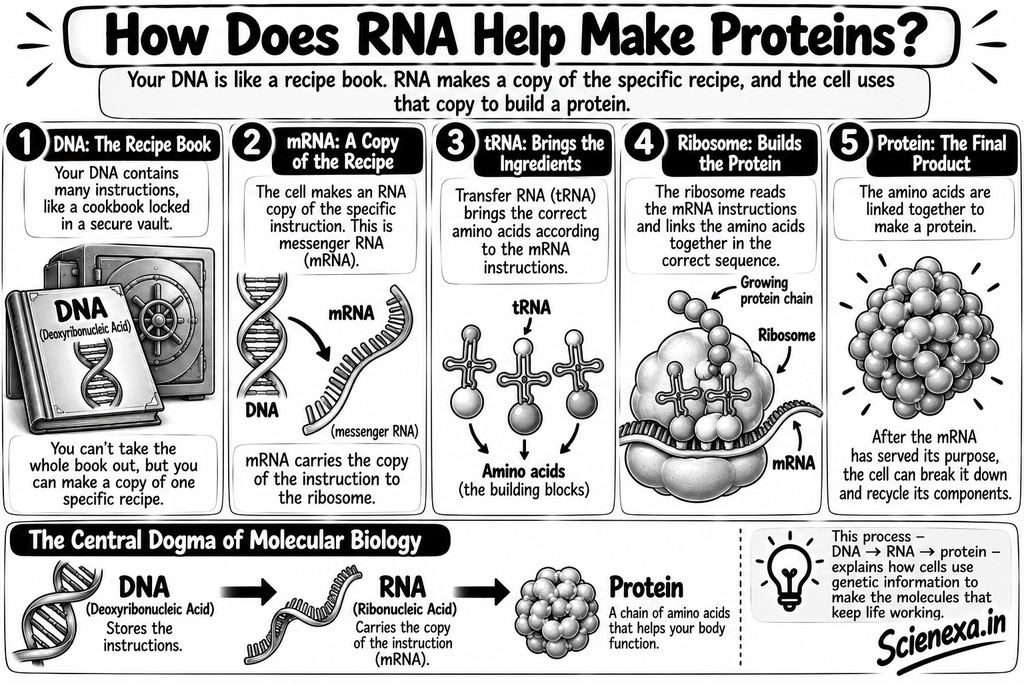
The process becomes easier to understand with a simple analogy. Imagine that your DNA is an enormous family cookbook locked inside a secure vault. You need one particular cake recipe, but you can’t take the cookbook out. First, the cell makes an RNA copy of that specific recipe. This is mRNA. The mRNA then travels to a ribosome, where the instructions are read. Next, tRNA brings the correct amino acids according to those instructions. The ribosome links the amino acids together in the proper sequence, eventually producing a protein. Once the mRNA has served its purpose, the cell can break it down and recycle its components. This process—often summarized as DNA (Deoxyribonucleic Acid) → RNA (Ribonucleic Acid) → protein—is a fundamental part of molecular biology and is commonly associated with the central dogma of molecular biology.
Why Is RNA So Important?
Proteins perform an enormous range of jobs inside your body. They can act as:
- Enzymes that accelerate chemical reactions
- Structural proteins that help build tissues
- Hormones and signaling molecules that coordinate biological processes
- Transport proteins that move substances around cells
- Antibodies that help your immune system recognize threats
- Receptors that allow cells to respond to signals
RNA (Ribonucleic Acid) helps turn the information stored in your DNA into many of these functional molecules. In other words, DNA stores the instructions, but RNA helps put those instructions to work.
Why Is RNA Changing Modern Medicine?
For decades, DNA dominated conversations about genetics. But scientists have increasingly recognized RNA (Ribonucleic Acid) as a powerful tool for medicine. One of the biggest breakthroughs came from mRNA technology. Scientists can design synthetic mRNA that provides cells with instructions for producing a specific protein. Once the cells produce that protein, the resulting biological response can potentially be used for medical purposes. This technology played a major role in the development of mRNA vaccines, including vaccines developed against COVID-19.
Researchers are also investigating RNA-based approaches for areas such as:
- Cancer treatment
- Genetic diseases
- Infectious diseases
- Protein replacement
- Personalized medicine
- Gene regulation
RNA (Ribonucleic Acid) isn’t simply a messenger between DNA and proteins. It can also regulate genes, influence cellular processes, and perform specialized biological functions.

RNA: The Cellular Messenger That Gets Things Done:
DNA may hold the master instructions, but RNA (Ribonucleic Acid) helps bring those instructions to life. From carrying genetic messages with mRNA, to helping build proteins through rRNA, to delivering amino acids with tRNA, RNA keeps the cell’s molecular machinery moving. And as scientists continue learning how to design and manipulate RNA, this remarkable molecule could become one of the most powerful tools in modern medicine. DNA stores the information. RNA delivers and interprets the instructions. Proteins do the work. That simple chain helps explain how the information encoded inside your cells ultimately becomes the biology that makes you you.
Medical disclaimer: This article is for educational purposes only and does not replace professional medical advice, diagnosis, or treatment.